
.png?width=1448&height=1086&name=Feedlot%20Solutions%20(48).png)
3 minute read
Working a chute is a two-handed job. Every animal still ends with the same tap on the tablet: Save or Continue, then back to the head gate. One tap is nothing. Three hundred of them, with wet gloves, on a tablet you have to walk over to, is a real cost in time and missed records.
Auto Continue in FLS Cloud takes that tap away. Turn it on once for the run, and the medical screen saves each animal on its own—from the scale on inductions, from the next scan on processing and treatments—and is ready for the next head before you are.
Where to find it
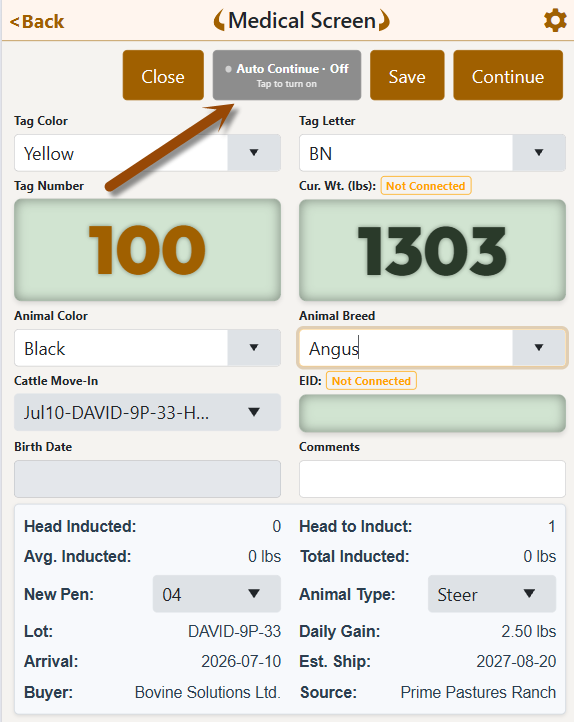
Auto Continue sits beside Save and Continue on the three mobile medical forms that work animal by animal: Induct (IN), Process (PR) and Treat (TR).
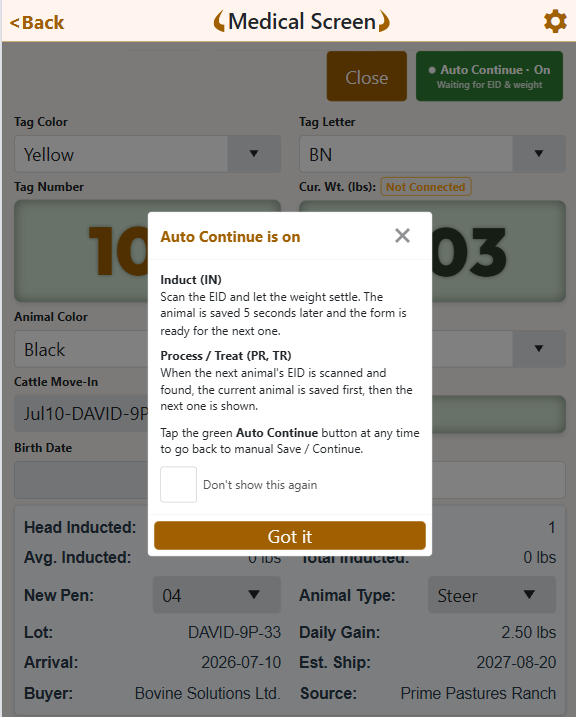
It starts grey, reading Auto Continue · Off – Tap to turn on. Tap it, or press and hold Continue for one second, and it turns green: Auto Continue · On. Save and Continue step aside, and the button's second line tells you what it is waiting for.
Tap the green button at any time to go back to manual Save / Continue.
Inductions: saved when the weight settles
On the IN form, Auto Continue watches two things—the EID and the scale:
- Scan the animal. The EID fills in.
- Let the animal stand. The weight box turns green while the countdown runs: Saving in 5s, 4s, 3s…
- Once the weight has held steady for five seconds, the animal is saved exactly as Continue would save it, and the form clears for the next one.
"Steady" allows for a scale that flickers: the reading may move by 1% of the weight (at least 2 lbs) without restarting the count. An animal shifting its feet and moving the reading more than that starts the five seconds again, so a half-settled weight is never saved.
For example, a 612-lb calf can wander between 606 and 618 lbs and still be saved after five seconds. A jump to 640 lbs restarts the clock.
Processing and treatments: saved on the next scan
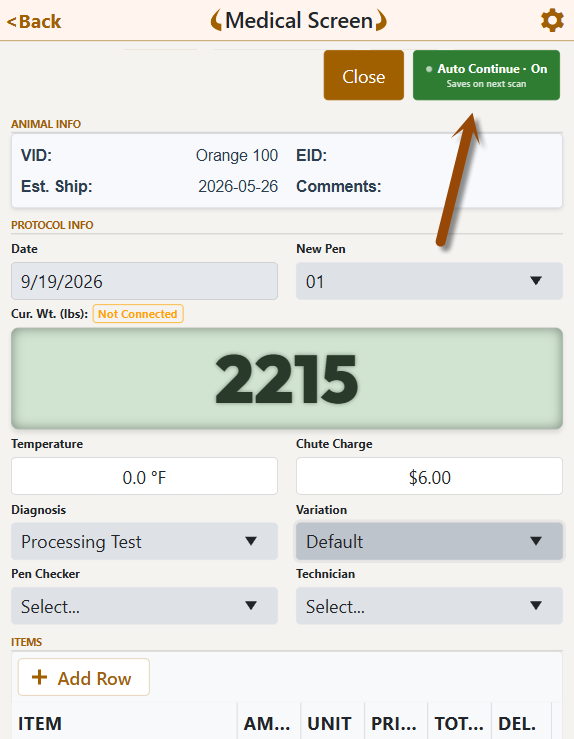
On the PR and TR forms there is no weight to wait for, so the trigger is the next animal:
- Work the current animal: diagnosis, variation, items.
- Scan the next animal's EID.
- The button counts down one second—Saving 4512 in 1s—then saves the current animal and shows the next one.
Scanning the same animal twice does not save it twice; the screen says Same animal – not saved again and stays where it is. A newer scan during the one-second countdown simply restarts it.
When a save cannot go through
Auto Continue never saves something FLS would refuse by hand. If validation stops the save—a missing diagnosis, an item without an amount—the form stays open with the usual message, the tablet plays the same alert tone the load sheet uses, and the button reads Not saved – fix the form, then scan again.
Auto stays on. Fix the form, scan the EID again, and the countdown resumes. Nothing is skipped and nothing stalls quietly in the background.
Important safeguards
- Auto Continue is off every time a form opens. It is not remembered between visits and not shared between devices, so a new run always starts in manual mode.
- It appears only on forms that have a Continue: new inductions, processing and treatments. Editing an existing animal or saving a scheduled protocol is always manual.
- A save already in progress is never interrupted; the next countdown waits for it.
- The one-second hold on Continue that turns Auto on will not also fire a manual save.
- The first time you turn it on, a short explanation appears. Tick Don't show this again to skip it on that device.
Available in FLS Cloud
Auto Continue is available now in the FLS Cloud mobile app on the Induct, Process and Treat screens, at no additional cost. It makes a long run at the chute a matter of scan, settle, next—with every record saved the same way a tap on Continue saves it.
If your crew still walks to the tablet after every animal, open the IN, PR or TR form on the next run, tap Auto Continue, and let the chute set the pace.
Not using FLS Cloud yet? Feedlot Solutions provides the most comprehensive, cloud-based management software for the modern beef producer. From inventory and health records to precise feed billing and custom reporting, we help you measure it so you can manage it.
Click here to schedule a demo.
Keywords: Feedlot management software, feedlot record keeping, custom feedlot billing, cattle closeout reports, feedlot closeout, cattle performance analysis, ration tracking, feed inventory, yardage billing, cattle health records, feedlot accounting, custom feeding software, grain bank, cattle medical, cattle inventory, cattle movements, cattle tag management, average daily gain, ADG, dry matter intake, DMI, feed conversion ratio, FCR, feed efficiency, gain efficiency, cost of gain, COG, break even analysis, cattle closeout report, pen closeout, lot closeout, group closeout, feedlot closeout report, cattle profit loss, cattle margin analysis, cattle weight gain tracking, cattle average weight, cattle shrink, cattle days on feed, DOF, cattle projected finish date, feed management software, feed inventory software, feed tracking software, feed delivery records, feed consumption tracking, feed cost tracking, feed ingredient inventory, ration management, ration tracking, ration formulation, ration cost, ration changes, ration history, daily feed records, feed bunk management, bunk reading, feed call, feed sheets, feed tickets, feed usage reports, ingredient usage, feed mixing records, TMR records, total mixed ration, feed truck records, feed scale integration, scale head data import, Cattle accounting software, feedlot accounting software, cattle billing software, cattle invoice software, feedlot invoice, feedlot customer billing, owner billing, cattle owner statements, yardage billing, feed billing, medicine billing, processing charges, transportation charges, trucking charges, cattle purchase expense, cattle sale settlement, feedlot receivables, feedlot payables, feedlot financial reports, cattle cost reports, cattle expense reports, feedlot profitability
Comments